


Office Furniture Care Plan for Cleaning Inspection and Repair
An office furniture care plan should be written before the rooms are handed over, while product references, finish samples and installer contacts are still easy to find. Otherwise the first spill, loose hinge or scratched edge sends facilities staff searching through old messages for a material name. For a GOJO project, connect each care instruction to the quoted item and approved finish rather than applying one generic routine to every desk, cabinet, chair and table.
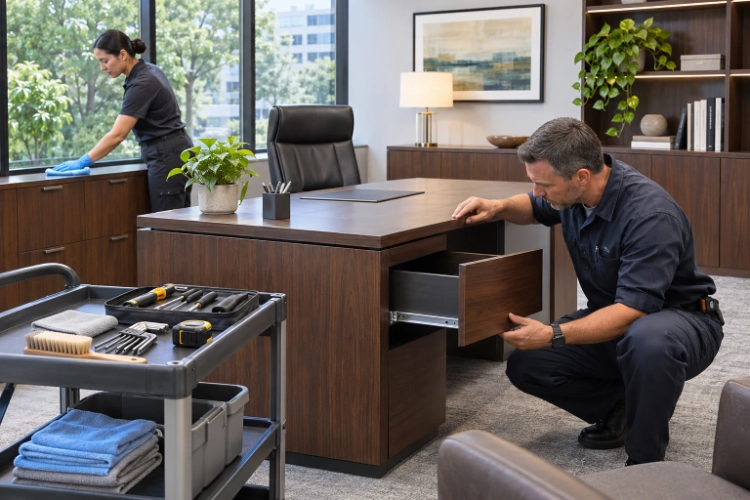
Build the asset list from the final order
Start with the room schedule and as-installed drawing. Give each repeatable configuration a stable code, then record its location, product or drawing reference, finish and major components. A desk with a return, power module and pedestal requires a more useful record than “executive desk, brown.”
Attach the approved care information to that code. The cleaning team should not have to decide whether a wood-look surface is veneer, laminate or another finish by examining it in the room. If the supplier has not named the surface or approved products, treat that as an open handover issue.
Separate replaceable parts from the main asset. Hinges, drawer runners, glides, locks, cable covers and power accessories may follow different inspection or replacement routes. Record enough information to identify them without dismantling the furniture. Avoid promising that a part is replaceable until the supplier confirms it for the selected configuration.
The GOJO product overview can help classify furniture by room and family, but the final order remains the control document. Care instructions belong to the delivered item, not to a similar photograph elsewhere in the range.
Divide cleaning from technical inspection
Cleaning and maintenance often happen together on a calendar but should remain distinct tasks. Cleaning removes dust, fingerprints and approved spill residues. Technical inspection checks movement, fixings, alignment, cable access and visible damage. Asking a cleaner to tighten unknown hardware, or asking a technician to choose a chemical from appearance, creates avoidable risk.
Set simple reporting boundaries. A cleaner may record that a drawer no longer closes flush, a table moves unexpectedly or an edge has lifted. The technician can then inspect the cause using the supplier’s instructions. Staff should not conceal a developing issue by forcing a component back into place.
Describe escalation in ordinary language. Movement, an exposed sharp edge, damaged electrical accessories or an unstable component may require the item to be taken out of use until the responsible person assesses it. The plan should name that responsible role and the contact route; it should not ask frontline staff to diagnose a structural or electrical fault.
Write a surface routine for each material group
For every finish, record the approved method, product type, dilution if applicable, cloth or tool, drying step and prohibited treatments. Do not copy a routine from one project merely because two surfaces have a similar colour. A cleaner suitable for glass or metal may affect a coated panel, upholstery or natural-finish sample differently.
Start with the least aggressive approved method. Remove loose grit before wiping so particles are not dragged across the surface. Address spills within the supplier’s guidance and avoid leaving moisture at joints, edges and openings. These are process principles, not a substitute for the product-specific instruction.
Upholstery needs its own record. Note whether routine work is limited to vacuuming, spot response or a named professional method. Keep unverified stain-removal recipes out of the plan. A small hidden-area test may be appropriate only when the supplier’s care information permits it.
The GOJO discussion of laminate and veneer desks shows why a finish name, edge treatment and cleaning method belong in one written package. It should not be used to guess the construction of a specific desk. Confirm the material against the quotation and retained sample.
Inspect moving and high contact parts
Create a short route through each room. Begin with stability and visible condition, then operate doors, drawers, locks, adjustable parts and cable covers that staff use. Look for a change from the recorded handover condition: new movement, rubbing, misalignment, noise, loose hardware or a damaged edge.
Frequency should follow use and consequence. A busy shared table or reception cabinet may justify more frequent observation than storage opened once a month. Do not invent one interval for every asset. Start with the supplier’s maintenance guidance, room use and facilities risk assessment, then adjust the schedule when the issue log reveals a pattern.
High-contact points deserve attention because small faults appear there first. Check handles, arm contact areas, front edges and the places where chairs approach a desk. For cable-managed furniture, confirm that covers still close and leads are not trapped by drawers or stored items. Electrical components should be assessed by an appropriately responsible person under the project’s requirements.
The GOJO office furniture category can support a room-by-room inventory of desks, tables and storage. Ask for the current drawing and hardware information for the exact pieces delivered; never transfer dimensions or mechanisms between collections.
Record a defect before trying to solve it
A useful report identifies the asset code, room, date, exact location and observed condition. Add photographs from a wide view and close view. Include the action that reveals the problem: “right drawer rubs during the final third of closing” is more useful than “drawer bad.”
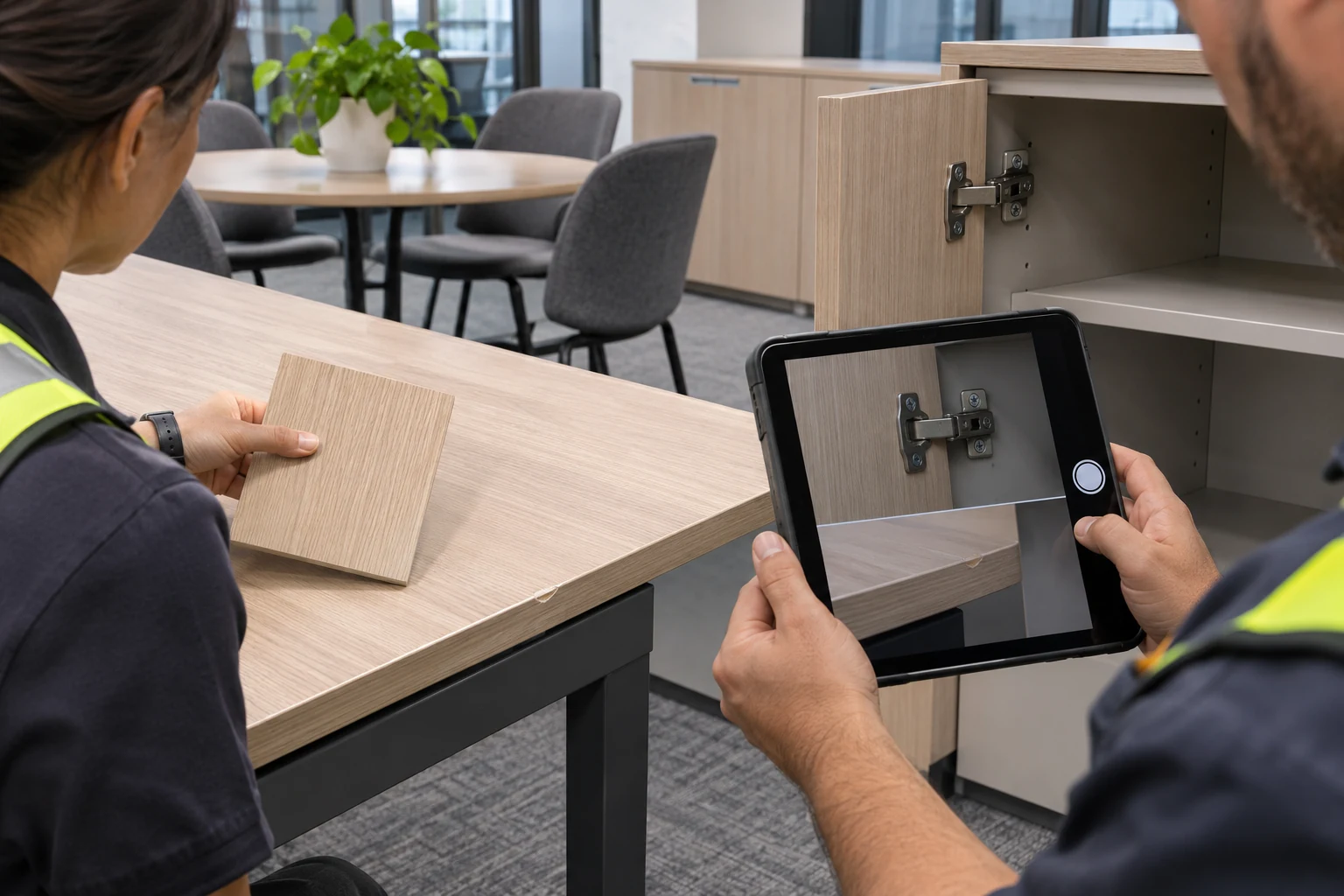
Keep the photographs honest. Use neutral light where possible and place a simple scale beside small damage. Do not edit out surrounding features that help locate the issue. A close-up of a chip without the room or item reference will be difficult to match later.
Preserve the part and finish evidence. If an edge or panel is damaged, compare it with the retained approved sample rather than a phone image from the original selection meeting. Record any batch or component reference supplied with the order. This gives the supplier a better starting point for proposing repair or replacement.
Do not let the issue log become a collection of open photographs. Assign an owner, next action and review date. Close the record only when the agreed response is complete and the furniture has been checked in its normal operating condition.
Decide when to clean repair adjust or replace
Different symptoms lead to different work. A removable surface mark may call for the approved cleaning method. A door that has moved out of alignment may require an adjustment following the hardware instructions. A damaged edge or failed component may need a supplier-approved repair or replacement. The plan should help staff route the issue, not encourage an unqualified repair.
Consider the context before accepting a cosmetic fix. A touch-up in a concealed cabinet may be reasonable, while the same visual result on the front of a reception counter may not meet the agreed finish expectation. Record who can accept the outcome and what sample or handover condition it is being compared with.
Repeated faults deserve a broader review. If the same hinge loosens in several rooms, check configuration, installation, use and part information before treating every case as isolated. The pattern may affect spare quantities, inspection frequency or the conversation with the supplier. Do not claim a product defect until the evidence supports that conclusion.
Keep care access in the furniture layout
Furniture cannot be maintained if ordinary service points are blocked. Show access to cable covers, floor boxes, wall outlets, adjustable feet and joining hardware on the as-installed plan. If a cabinet must be emptied before a connection can be reached, record that operating condition.
Cleaning access matters as well. Tight gaps behind freestanding storage may collect dust but remain too narrow for normal tools. A heavy sofa or table should not need frequent moving solely because the layout ignored access. Feed these findings back into future room standards instead of leaving every cleaning team to improvise.
When work requires furniture to move, document how the floor and adjacent pieces will be protected. Mark the original position before displacement, then recheck level, alignment, cable routing and circulation after return. A care task is incomplete if it creates a new route obstruction or traps a lead.
GOJO’s technical support information describes group-level capabilities. For a maintenance question, request the documents and part information that apply to the selected item. Broad testing or service capability does not establish the correct repair method for every configuration.
Assemble the handover care file
Keep the final asset schedule, drawings, finish record, care instructions, parts information, inspection routine and issue-log template together. Name the document owner and the place where updates are stored. A paper folder left in one room will quickly fall behind the actual furniture estate.
Walk through the routine with facilities and cleaning representatives before handover. Ask each person to locate an asset code, identify the approved cleaning instruction and raise a sample defect. The exercise exposes missing references while the project team can still resolve them.
Send unresolved product, material and hardware questions to the GOJO contact team with the item code, order reference, room, photographs and requested information. Ask for written instructions tied to the delivered configuration. A good care plan makes the first response quicker and preserves evidence for later decisions.
FAQ
What should an office furniture care plan contain
Include the asset schedule, product or drawing references, finishes, approved cleaning methods, inspection tasks, responsible roles, defect-report fields, parts information and supplier contact route.
How often should office furniture be inspected
Use the supplier’s guidance, room use and consequence of failure to set the interval. Review the schedule when issue records show repeated wear or movement. One frequency rarely suits every room and item.
Can one cleaner be used on every office surface
Not safely by assumption. Record the approved method for each finish and upholstery group. Similar colours do not prove the same material, coating or chemical compatibility.
What photographs are useful in a furniture defect report
Take one wide image locating the item and one close image showing the condition. Include the asset code, room, date, exact position and the action that reveals the fault.
When should furniture be taken out of use
Follow the project’s risk procedure when an item is unstable, exposes a sharp edge, has damaged electrical accessories or could worsen through continued use. Name the responsible person who decides the next step rather than leaving diagnosis to the reporter.


