

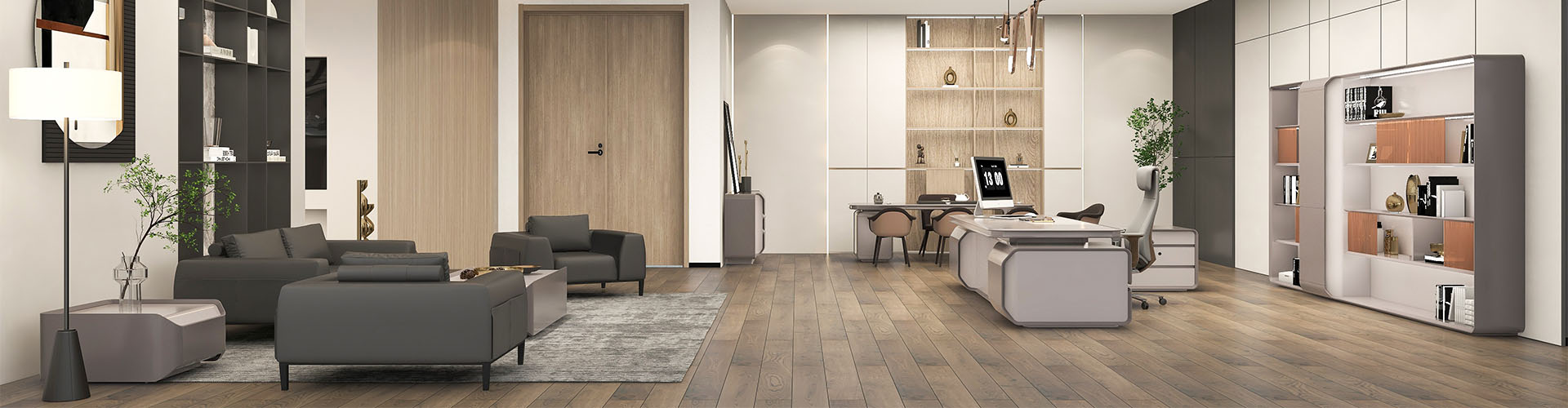
Contemporary Home Office Furniture: 8 Features That Matter Most
Contemporary home office furniture should do more than look current. It should hold screens and paperwork, hide cables, support a comfortable posture, and suit a residential room. The eight features that matter most are clean lines, balanced materials, ergonomic proportions, useful work space, accessible storage, cable management, efficient layouts, and durable construction.
A desk can photograph beautifully and still become irritating by Wednesday afternoon. Daily details decide whether it remains pleasant after months of work.
What Gives Contemporary Home Office Furniture a Modern Identity?
A contemporary room depends on proportion, texture, restrained color, and the way each item relates to the walls and floor. Office furniture must look professional without turning a spare bedroom into a boardroom.
Clean Visual Lines
Clean lines reduce visual weight. Straight edges, softened corners, concealed handles, and well-proportioned supports create a calm outline. Exposed brackets and wiring add clutter before you place anything on the desk.
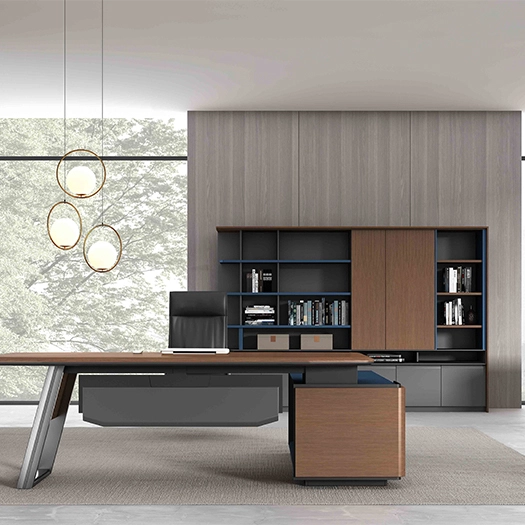
The VNA collection provides a useful example. Published information describes straight-grain walnut visuals, matte blue and gray finishes, warm gray metal details, a rounded frame, and slanted supports. The contrast gives the desk depth while keeping the form controlled rather than decorative.
Balanced Materials and Colors
Wood grain adds warmth, while matte paint and metal bring a cleaner architectural feel. Repeat one tone already present in the room. A walnut-colored top may connect with the floor, while a warm gray frame can sit quietly beside neutral walls.
Gloss also deserves attention. A reflective surface may show fingerprints and catch window glare. GOJO presents its commercial furniture portfolio as part of wider space solutions. Its company background covers several commercial settings, which matters when a workspace needs to feel planned rather than pieced together.
How Should Furniture Support Your Daily Work?
Appearance matters, but your body notices poor dimensions faster than your eyes notice a fashionable finish. The desk, chair, keyboard, monitor, and storage should work as one setup. This is where contemporary home office furniture becomes either a dependable tool or an expensive inconvenience.
Ergonomic Working Proportions
Ergonomics begins with relationships, not one “correct” desk height. Your elbows should remain close to your body and your wrists should stay straight. Official workstation guidance recommends an elbow angle between 90 and 120 degrees, places the monitor center 15 to 20 degrees below horizontal eye level, and lists a seated keyboard range of 22 to 30 inches, or 559 to 762 mm.
| Workstation Point | Published Guidance | What to Check |
|---|---|---|
| Elbow angle | 90–120° | Shoulders remain relaxed |
| Monitor center | 15–20° below eye level | Screen can sit at a comfortable height |
| Seated keyboard height | 22–30 in. adjustable range | Chair or tray can match your elbow height |
| Work-surface thickness | Generally no more than 2 in. near the keyboard | Drawers do not press against your thighs |
A drawer directly below the top can reduce thigh clearance. Storage only helps when it does not disturb your posture.
A Generous Work Surface
A wide desk can still feel cramped when equipment and papers compete for the center. Keep the monitor and keyboard in the primary zone, then use a return for writing, samples, or printed plans.
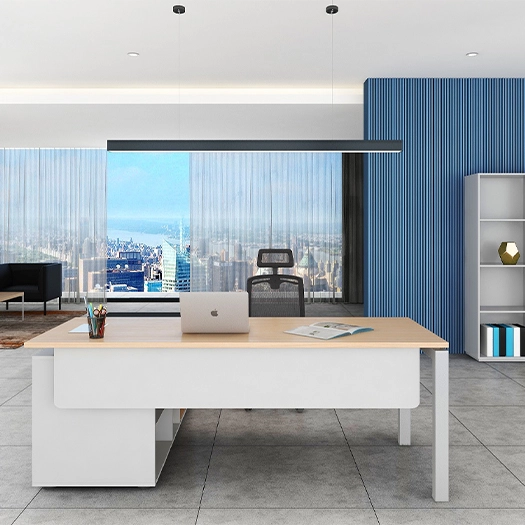
The Fupin collection is presented as a neat L-shaped option for regular office work, with useful depth and practical side storage rather than heavy decoration. Its layout can separate screen work from paper review and use a corner that might otherwise stay empty. It also gives your coffee a safer address, which is not a technical specification but still matters.
Which Features Keep a Home Office Organized?
Clutter is often a furniture problem before it becomes a tidying problem. If chargers have no route and files have no cabinet, the desk will look messy again soon after you clear it. Good contemporary home office furniture treats storage and wiring as part of the structure.
Integrated and Accessible Storage
More storage is not always better. Large cabinets can narrow the chair area and add visual bulk. Keep daily notebooks in a shallow drawer, active files within reach, and archived material farther away. Closed compartments suit video calls because they hide irregular shapes and labels.
Fupin suits a work pattern that needs a clear split between the main desktop and side storage. VNA places stronger emphasis on an executive-style surface, attached cabinets, flexible drawer arrangements, and layered finishes. One published VNA-DEA-3224 configuration measures 3200 × 2400 × 750 mm, so it belongs in a generous room rather than a tight bedroom corner.
| Collection | Best Fit | Published Characteristics |
|---|---|---|
| Fupin | Everyday tasks and L-shaped zoning | Clean form, useful depth, practical side storage |
| VNA | Larger rooms and a formal look | Walnut visuals, matte finishes, rounded edges, cabinets, cable routing |
Hidden Cable Management
A modern desk may carry monitor cables, chargers, a lamp, a dock, and a power strip. Without a planned route, those lines collect behind the screen.
Look for cable openings near devices, an under-desk tray, reachable power connections, and space for adapters. VNA information describes built-in routing, while GOJO’s guidance discusses hidden channels, flip covers, and side cabinets. Confirm what comes with the chosen size because configurations may differ.
How Can Furniture Fit the Room and Remain Useful?
The final two features concern space and time. Furniture must fit the room today, then remain stable as your equipment or work habits change. Measure the room with the chair pulled back, not while it is empty.
Space-Efficient Layouts
Record the wall length, desk depth, door swing, window position, drawer-opening area, and walking route. Check where the chair sits when you stand up. A layout can look spacious on a floor plan and feel tight after the chair, waste bin, and visitor seat arrive.
L-shaped desks use corners well when the return sits on the correct side. They help when you need two work zones, but they are a poor choice when the return blocks a door or narrows the path beside a bed. When comparing contemporary home office furniture, tape the footprint on the floor. This plain method shows scale better than a product image.
Durable and Adaptable Construction
Check desktop stability, edge finishing, drawer movement, cabinet alignment, support strength, surface care, and cable access after installation. A desk should not wobble when you type or shift when you lean on the return.
GOJO states that its group was founded in 2004 and operates eight production bases covering about 300,000 square meters. Its technical support information describes a 500-square-meter testing center established in 2013, 75 main testing devices, and more than 80 physical and chemical reliability test projects. Testing areas include furniture mechanics, formaldehyde, salt spray, and controlled temperature and humidity.
These facts do not replace a product-specific specification sheet. Buyers still need finish details, drawings, care guidance, and warranty terms for the exact desk. The published contact channel is the formal route for clarifying dimensions and documentation.
Conclusion
The best contemporary home office furniture does not simply look modern. It supports your posture, gives each task enough room, hides the untidy parts of technology, and fits the home without taking it over. Fupin is the practical reference when you need L-shaped zoning and accessible storage. VNA suits a larger room where rounded lines, layered materials, and a formal presence carry more weight. Measure first, map your daily tasks, then judge materials and style.
FAQ
Q: What Is the Most Important Feature of Contemporary Home Office Furniture?
A: Start with fit. The desk must suit your room, chair movement, equipment, and daily tasks. A beautiful surface will not solve poor legroom or a blocked walkway.
Q: Is an L-Shaped Desk Suitable for a Small Home Office?
A: Yes, when it uses an empty corner without blocking movement. Measure the return, door swing, and chair pull-back area first.
Q: How Deep Should a Desk Be for Monitor Work?
A: There is no universal depth for every monitor and user. Choose enough depth to keep the screen at a comfortable viewing distance while supporting the keyboard and forearms.
Q: Which Is Better, Open Shelves or Closed Cabinets?
A: Closed cabinets suit files, chargers, samples, and irregular objects. Open shelves work better for books or a few visually tidy items.
Q: How Do You Compare Fupin and VNA?
A: Fupin is better aligned with practical L-shaped zoning and everyday storage. VNA has a more formal character, with rounded forms, mixed finishes, attached storage, and published cable-management features.


