

Office Furniture Procurement Checklist Before You Place an Order
A furniture quotation can look complete while leaving the expensive questions unanswered. Does the desk price include the return cabinet? Who unloads the delivery? Which finish did the buyer approve? These details belong in the order paperwork, before production starts.
For office furniture procurement, the useful sequence is straightforward: settle the layout, identify each item, approve the materials, compare the full delivery scope, and agree how the finished order will be checked. Price comparisons become much more useful once every supplier is quoting the same work.
GOJO supplies furniture for commercial office spaces. The checklist below follows the decisions a project buyer needs to make when turning a room plan into a furniture order, whether the project covers a few private offices or several shared work areas.

Start with a Room-by-Room Furniture Schedule
Give every room a name or number that appears on both the drawing and the quotation. Then list the furniture required there, including quantities and anything being retained from the existing office. “Twenty desks” tells a supplier very little if some are individual workstations and others are shared assemblies.
Record how each space will actually be used. A meeting room used for laptop presentations needs different power arrangements from a room used mainly for paper-based discussions. A private office that receives visitors needs space for them without blocking the person working at the desk.
The Canadian Centre for Occupational Health and Safety’s office working-space guidance considers equipment, storage, movement and the nature of the work. Apply that thinking to the plan. Draw the chairs in use, open the storage doors, and check the route between furniture groups. A tabletop outline alone will miss these conflicts.
Confirm the drawing revision before asking for prices. If the layout changes later, issue the revision to every supplier and identify the affected items. Otherwise, the lowest quote may simply describe an older, smaller scope.
Make Each Furniture Specification Clear Enough to Quote
A useful office furniture specification gives the supplier enough detail to price the item and gives the receiving team something concrete to inspect. Assign an item code to every different configuration. Use that code on the plan, quotation, approved drawing and packing list.
At minimum, each line should identify the product, quantity, assembled dimensions, finish and included components. State the measurement units. Where left- and right-hand versions are available, attach a marked plan or photograph showing the required orientation; descriptions can be interpreted differently depending on where the viewer stands.
Check What the Product Name Includes
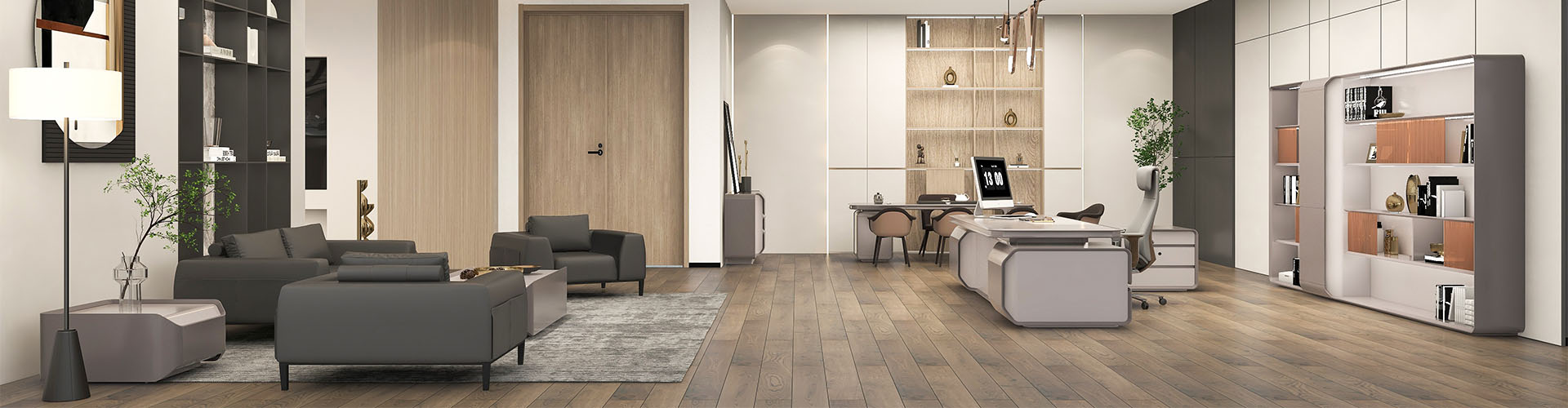
The RuiZe executive desk provides a practical example. Its website photograph shows an executive workspace with a substantial desk and side storage. For a quotation, identify the desk configuration separately from the chair, background cabinets and other furniture visible in the room. A styled product image is useful for selecting an appearance, but it does not establish the contents of an order.
RuiZe product image from the GOJO website. Confirm the supplied components against the quotation.
For a different desk arrangement, the Kanuo office desk is another specific product to discuss with the supplier. Ask for its current configuration drawing and available finishes. Compare the assembled footprint and storage arrangement with the room schedule before deciding which product belongs in the project.
Avoid approving an entire furniture series as a single line item. The buyer may be picturing the full scene while the supplier has priced only the main desk.
Resolve Power and Cable Details Early
List the equipment that must connect at each workstation or meeting table. Confirm the number and type of outlets, cable entry positions and the route back to the building supply. Ask who supplies and installs each electrical component.
If a desktop is to be cut for a power module, approve the module and cutout drawing before manufacture. Check that cables can be reached for servicing without dismantling the furniture. For export orders, have the relevant project specialist confirm that the specified electrical fittings suit the destination; a photograph cannot establish this.
Approve Samples and Ask for Relevant Test Documents
Screen colours are a poor basis for signing off a large furniture order. Request physical finish samples for the selected surfaces and upholstery. Label the accepted sample with its code and approval date, and keep a reference that both parties can identify.
For mixed-material furniture, review the materials together. A woodgrain that works on its own may look quite different beside the chosen metal finish or fabric. Agree how visible variation will be assessed, particularly where natural materials are involved.

Kanuo product image from the GOJO website. Use a physical sample to approve colour and surface finish.
A sample workstation also helps reveal problems that a colour swatch cannot. Try the intended chair at the desk, check drawer travel, and place the actual monitor and equipment where they will be used. Keep the observations specific: “drawer hits chair arm” is something the supplier can resolve; “the desk feels wrong” is harder to act on.
GOJO’s technical support information describes testing capabilities for furniture and materials. When a project requires evidence, request the relevant report and check which product, material or configuration it covers. Laboratory capability alone does not show that every item in a quotation has passed a particular test.
Have the project team identify applicable local requirements before the order is released. Avoid copying a certification label from a supplier brochure into the purchase specification without checking its scope.
Compare the Cost of a Completed Installation
Put quotations into the same comparison sheet. A desk price excluding delivery and assembly cannot be compared directly with a price that includes both. Ask suppliers to show exclusions clearly rather than leaving the buyer to infer them.
|
Cost or responsibility |
What to confirm |
|
Furniture and accessories |
Exact quantities, configurations and included parts |
|
Packing and freight |
Packing method, delivery point and transport scope |
|
Import and destination charges |
Who arranges clearance and pays applicable charges |
|
Site handling and installation |
Unloading, floor delivery, assembly and waste removal |
|
After-sales support |
Warranty scope, spare parts and the claims process |
For international orders, write the agreed trade term and named place into the quotation. Check the responsibilities with the freight provider. “Shipping included” is too vague to establish who will handle charges or work at the destination.
Keep optional items separate from the approved base order. If a lower price depends on changing a finish, omitting storage or reducing a quantity, show that change beside the saving. This lets the purchasing team make a deliberate choice instead of discovering it when the furniture arrives.
Put Delivery and Acceptance Checks in Writing
Work backwards from the date the space must be usable. Ask the supplier to distinguish drawing approval, sample approval, production, inspection, dispatch and installation. A dispatch date is not an office opening date.
Before confirming delivery, check access with the building team: unloading arrangements, lift dimensions, door openings and permitted working hours. For larger desks and tables, request the dimensions and weights of the largest packed components. Compare those with the actual route into the room, not just the finished furniture size.
Agree how cartons will be labelled so the installation team can match them to the room schedule. If the order arrives in phases, each phase needs its own clear list of items and outstanding parts.
Set the acceptance checks before shipment. These might cover quantities, approved finishes, visible damage, dimensions and the operation of drawers or adjustable components. Record defects against the item code, supported by photographs. Name the person responsible for resolving each issue and agree the handover process in the contract.
A Short Checklist Before You Release the Order
Use this final check with the quotation open beside the approved drawings:
- Does every item match the latest room schedule and layout revision?
- Are dimensions, finishes, orientation and included accessories recorded?
- Can both parties identify the approved samples and required test evidence?
- Are freight, destination handling, installation and exclusions explicit?
- Has the building team checked the delivery route and working arrangements?
- Are inspection, defect reporting and after-sales responsibilities agreed?
For a GOJO project enquiry, send the floor plan, furniture schedule and required completion date through the project contact page. Include the product references you are considering and mark any details that still need clarification. That gives the quotation discussion a useful starting point and makes later changes easier to track.
Frequently Asked Questions
What should an office furniture RFQ include?
An office furniture RFQ, or request for quotation, should include the current floor plan, a room-by-room item schedule, quantities, product specifications, finish references, delivery location and required timing. Ask the supplier to identify assumptions and exclusions in the response so you can compare offers on the same basis.
Should you choose custom or standard furniture?
Start with standard configurations that meet the room and work requirements. Consider custom furniture where a specific size, function or finish cannot be met otherwise. Ask how the change affects samples, drawings, price, production timing and future replacement parts before approving it.
Does a product photograph confirm the supplied configuration?
No. It shows an arrangement to discuss. Confirm the exact model or configuration, dimensions and included components in the quotation and approved drawing. Treat chairs, lighting, screens and surrounding cabinets as separate items unless they are expressly included.


