

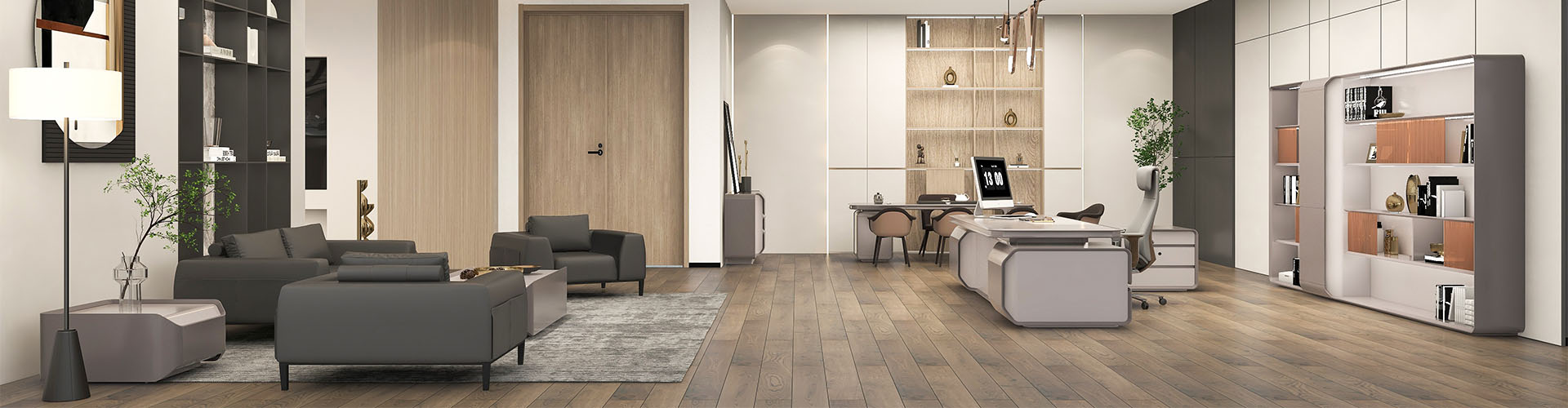
What Is the Best Furniture for a Home Office? 8 Buying Mistakes to Avoid
What is the best furniture for a home office? The key to choosing good home office furniture is to try before you buy, to test it out in your home and see how it really works for you, your body, your equipment and your routine.
A stylish online picture of a beautifully designed desk can soon become a disaster when it arrives at your home and proves to be too wide to go through the doorway. A beautifully designed cabinet with loads of storage space could look great online but would be of little use if it means that you have no room to move around your chair. The perfect home office furniture needs to provide a good work surface, storage, neat cable management and be of a style that sits happily alongside other residential items of furniture.
GOJO develops modern business furniture around complete office settings. Its published company background covers executive, meeting, staff, reception, and storage spaces. That approach suits a home office that must handle focused work, video calls, paperwork, and occasional meetings.
Why Does Space Planning Matter before You Buy?
Many home offices fail during the first measurement. People check the wall and forget chair movement, cabinet doors, window access, and the path to the seat.
Mistake 1: Buying a Desk before Measuring Its Full Footprint
Record the desk’s width, depth, height, attached cabinet position, and left- or right-hand orientation. Mark the footprint on the floor with removable tape before ordering.
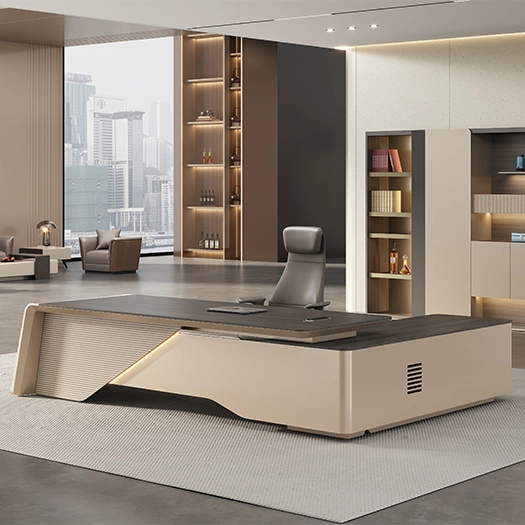
The LingRui executive desk is listed in 3200 × 2400 × 750 mm and 2800 × 2400 × 750 mm versions. Matching file cabinets reach 3800 or 3200 mm in width and 2150 mm in height. These sizes suit a dedicated study better than a spare-bedroom corner. The curved form has strong visual presence, but it needs room around it.
Mistake 2: Ignoring Chair Movement and Cabinet Clearance
A desk can fit on paper and still be awkward. Leave room for the chair to roll back without striking a wall, bed, or cabinet. Check that drawers open while you are seated and that cabinet doors do not collide with curtains or room doors. A standing mat also needs floor space.
| Configuration | Listed Size | Planning Envelope | Practical Room Fit |
|---|---|---|---|
| LingRui large executive desk | 3200 × 2400 × 750 mm | 7.68 m² | Large dedicated office |
| LingRui smaller executive desk | 2800 × 2400 × 750 mm | 6.72 m² | Spacious private study |
| Kanuo executive desk | 2200 × 1900 × 750 mm | 4.18 m² | Medium home office |
| Kanuo compact executive desk | 1600 × 1600 × 750 mm | 2.56 m² | Smaller enclosed office |
The envelope figures come from multiplying listed width and depth. They show the floor rectangle to reserve before adding chair clearance.
What Is the Best Furniture for a Home Office When Comfort Comes First?
Once the layout works, comfort becomes the next filter. A stylish surface cannot make up for poor reach, cramped legs, or a monitor placed too close.
Mistake 3: Choosing Appearance over Working Posture
Most fixed executive desks in these ranges have a listed height of about 750 mm. Please note that this is a reference, not a guarantee that the desk will fit everybody. Use a chair when your feet are flat on the floor, your upper arms are at right angles to your body and your hands are at the same height as your work surface. Also position your screen at a distance so that you are not leaning forward to view it.
Curved edges and softened corners reduce the heavy feel common to large executive desks. Even so, posture should decide where the keyboard, screen, and frequently used documents sit.
Mistake 4: Using One Surface for Every Activity
A crowded surface creates daily friction. When we want to put our laptop on the desk it has to compete with papers, printer, power-chargers, notes and that coffee-cup that always finds its way to the safest cable-free spot on the desk. Organize the room in a computer zone, a paperwork zone and a storage zone.
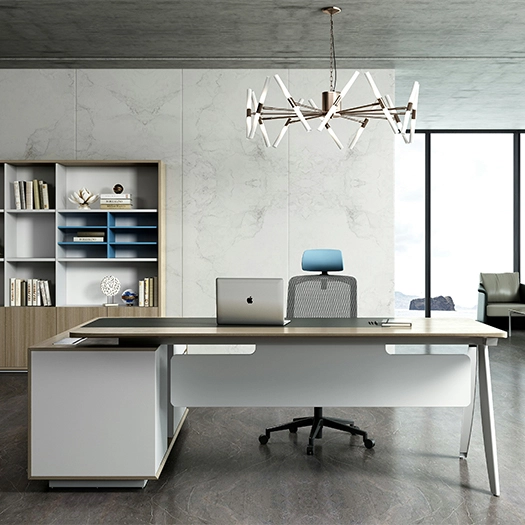
The Kanuo range offers executive desks from 2200 × 1900 mm down to 1600 × 1600 mm, plus negotiation tables, filing cabinets, and modular staff configurations. This lets you scale the furniture to the room instead of making one oversized desk handle every task.
Which Functional Mistakes Create Clutter and Daily Friction?
When storage, power, and equipment placement are treated as later additions, the room fills with adapters, loose papers, and temporary boxes.
Mistake 5: Treating Storage as an Afterthought
Sort storage into four groups: active files, confidential records, display items, and technical supplies. Active files belong within reach. Private records need closed storage. Books can use open shelves, while spare cables and printer supplies are better hidden.
This is where what is the best furniture for a home office becomes a practical question rather than a style debate. LingRui cabinets combine open display sections with closed storage, while Kanuo cabinets use modular combinations and adjustable internal space. Choose the smallest plan that handles your real inventory.
Mistake 6: Forgetting Cable and Power Management
Count every powered device before choosing the desk: computer, monitor, task light, phone charger, router, speakers, and printer. Then locate the wall socket. A desktop power point is convenient only when its cable can reach the wall without crossing a walkway.
The LingRui desk includes a rotating-cover socket, while Kanuo side cabinets combine equipment placement, storage, and cable routing. These details keep wires within the furniture instead of draped across the desktop. The manufacturer’s technical support information also describes its testing facilities and product categories.
Which Quality and Style Mistakes Cause Long-Term Regret?
Surface wear, loose hardware, unstable joints, and mismatched finishes appear slowly. The showroom glow fades; the drawer still has to open every morning.
Mistake 7: Choosing the Lowest Price over Tested Durability
Could you please provide me with a detailed description on how the manufacturer tests the desk, the cabinet, the hardware, the finish and the packaging. As mentioned in the published information, the manufacturer has a testing center which was set up in 2013 and covers an area of about 500 square meters. The center is equipped with 75 sets of main testing machines with total value over RMB 6 million. The center can conduct more than 80 types of physical and chemical and reliability tests. The tests include furniture mechanics, formaldehyde release, salt spray test, temperature test and humidity test, etc.
These figures show what a serious quality process looks like. Product choice should combine measurable fit with verified construction. The published project contact details provide a reference point for questions about dimensions, orientation, and configuration.
Mistake 8: Mixing Furniture without a Clear Design Language
A home office should not look borrowed from three unrelated workplaces. Choose one dominant wood tone, one secondary finish, and a consistent edge language. Curved desks pair naturally with rounded tables and softer seating. Rectilinear desks suit modular cabinets and cleaner wall arrangements.
LingRui uses California oak, low-saturation gray surfaces, curved forms, and layered lines for a sculptural executive setting. Kanuo offers teak or eucalyptus-based color schemes, beveled details, rounded edges, metal supports, and modular storage. The first needs room for a strong centerpiece. The second is easier to scale across medium and compact rooms.
Conclusion
When making a sound buying decision for furniture for your workspace, remember that the decision making process starts with the room and ends with the details of what you can touch and feel in that room.
Measure the furniture envelope to ensure correct use of the space. Protect the clearance around chair base. Ensure that the height of your desk is correct for the height of your chair. Create separate work zones. Plan your storage. Count the number of power needs in the space. Verify quality evidence for the products you are considering. Finally, make sure the visual language of all products in the space is consistent. It is costly to replace furniture that looked right in the showroom but didn’t work well in your space.
FAQ
Q: How much space should you leave behind a home office chair?
A: Leave enough room to roll back, stand, and turn without hitting a wall or cabinet. Test the space with the chair fully extended.
Q: Is a large executive desk suitable for a bedroom office?
A: Usually only when the room has a separate work zone. A 2800 × 2400 mm planning envelope will dominate many bedrooms and may block wardrobes, windows, or the bed.
Q: Should open or closed storage be used in a home office?
A: Use both. Open shelves keep books accessible, while closed cabinets hide supplies and protect private records.
Q: Why does built-in cable management matter?
A: It keeps chargers and power leads away from the main work surface, reduces cleaning problems, and lowers the chance of cables crossing a walkway.
Q: What is the best furniture for a home office with limited space?
A: Choose a desk with a verified footprint, integrated storage, carefully finished edges, and a cable route that reaches the wall socket. A smaller coordinated set usually works better than one large desk surrounded by unrelated cabinets.


